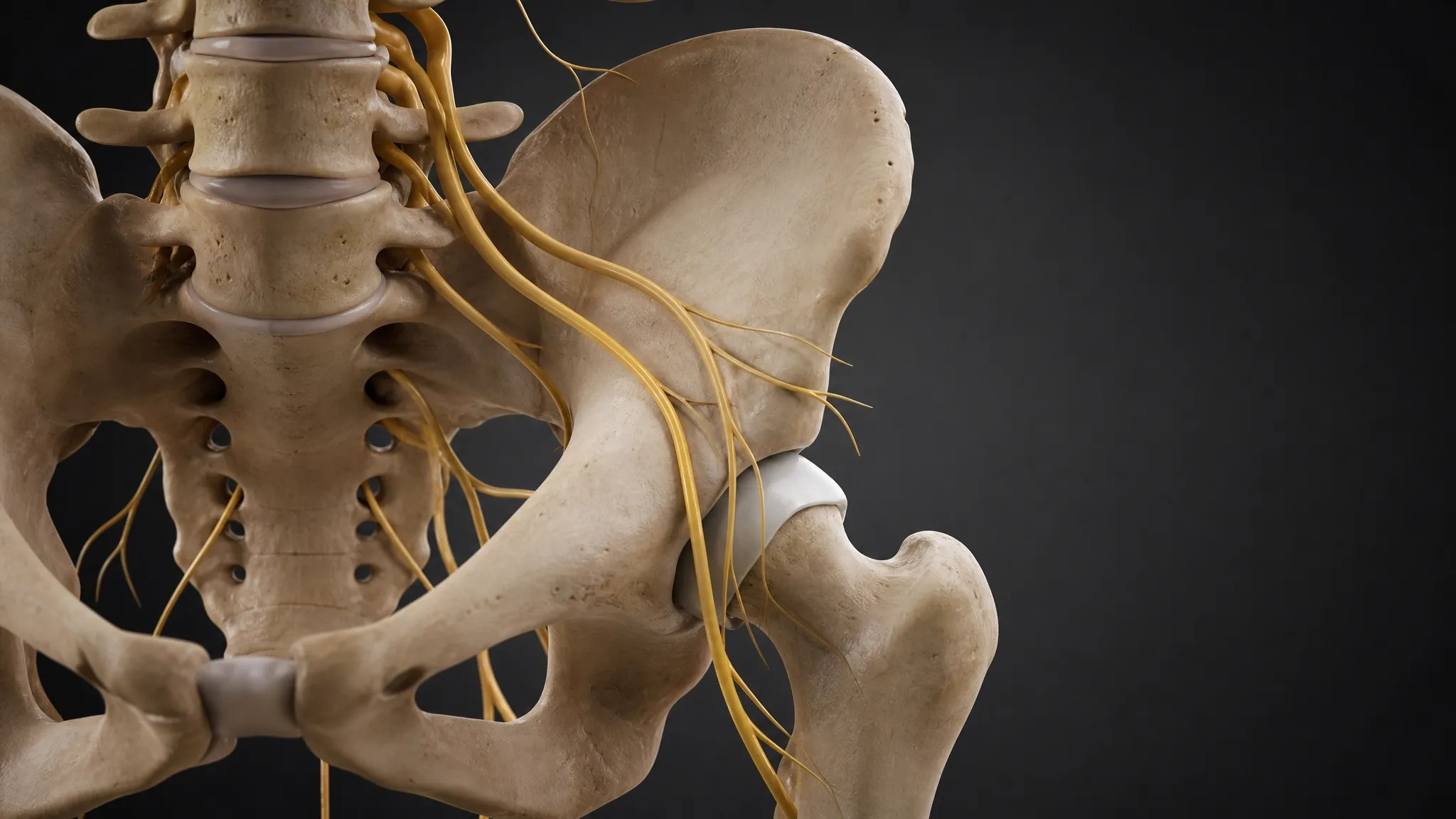
A 64-year-old woman came to us with pain in her right hip and a life shrinking around it. Walking and standing had become limited, the pain always waiting for her when she loaded the joint. An X-ray was taken and it showed osteoarthritis of the hip, moderate wear in the joint. With a symptom and a matching image, the path seemed obvious, and she was given a total hip replacement.
Then came the part that makes this case different from every other one in this series. The operation went ahead, the new joint went in, and her pain did not go away. She had been through major surgery, recovery and rehabilitation, and she was still standing exactly where she started, hurting.
That is the moment worth sitting with, because it exposes something the earlier cases only hint at. Here, the second opinion did not arrive in time to prevent anything. It arrived afterwards, to explain what had already happened.
If you have had a joint replaced and the pain is still there, that is not a sign that you are healing slowly. It is a sign that the pain may never have been coming from that joint.
The trap in her case is one of the most underestimated problems in orthopaedics: referred pain, where a problem in one part of the body is felt in another. Nerves that are irritated in the lower back can send pain down into the hip, groin, buttock and thigh, and the patient feels it exactly where a bad hip would hurt. Some clues help tell the two apart:
- Hip pain that comes from the joint is usually felt deep in the groin, worsens as you rotate or load the hip, and is often accompanied by stiffness and a reduced range of motion
- Hip pain referred from the spine tends to sit more in the buttock and the side or back of the thigh, and may extend below the knee
- Pain that changes with your back, worsening when you stand or walk for a while and easing when you sit or lean forward, points toward the spine
- Numbness, tingling or leg weakness points to nerves, not cartilage
- A hip that moves freely and painlessly when examined, despite severe reported pain, is a strong hint the joint is not the culprit
- An X-ray showing only moderate wear in a patient with severe pain should raise the question of whether the picture really explains the symptom
That last point matters enormously. Osteoarthritis on an X-ray is extremely common after sixty. Finding it does not prove it is the thing causing the pain.
What the first opinion concluded
Her first assessment came from orthopaedics, which saw hip osteoarthritis on the image and implanted a total hip replacement.
When a patient reports hip pain and the hip X-ray shows arthritis, replacing the joint feels like a straightforward, well-matched solution. The reasoning is intuitive, which is exactly why the error is so easy to make.
The problem was that the diagnosis rested on a coincidence. She had hip arthritis on the film, and she had hip pain, and those two facts were assumed to be the same fact. Nobody had established that the arthritic joint was actually generating her symptoms, and nobody had examined the alternative source sitting one level up. The image and the complaint pointed at the same place, and that was taken as proof, when it was only a correlation.
The second opinion
After the surgery failed to relieve her, she was referred to a spine centre for a medical second opinion. They did the investigation that had never been done: an MRI of her lumbar spine.
It showed spinal stenosis at the L3/4 level, a narrowing of the canal where the nerves run, compressing the nerve roots that supply the right hip region. That was the true source of her pain. It had been referring itself down into her hip the entire time, mimicking a bad joint so convincingly that a healthy-enough hip was replaced because of it.
She underwent a spinal decompression, an operation that relieves the pressure on the trapped nerves. Afterwards, her pain disappeared completely. And the artificial hip stayed in place, permanently, because there is no undoing it. It sits there today as a quiet reminder: it was never the cause.
Why this case matters
The lesson is blunt.
Operating in the right place matters just as much as operating well. Her surgery was competently done. It was simply done in the wrong part of her body.
The technical execution of the hip replacement was probably flawless. That is what makes the case so uncomfortable. Skill does not rescue a misplaced diagnosis, and a perfectly performed operation on the wrong structure still leaves the patient in pain, plus an implant she did not need and cannot return. Referred pain is systematically underestimated in preoperative assessment, and it is exactly the sort of thing an unhurried second look is good at catching. Clear communication in healthcare would have meant testing the assumption before the incision, asking out loud whether the arthritis on the film was truly the source, rather than allowing the picture to answer a question it was never able to answer.
A word of balance
This is not an argument against hip replacement, which is one of the most successful operations in modern medicine and transforms life for people whose pain genuinely comes from the joint. Hip arthritis and spinal stenosis can even coexist in the same patient, which makes these cases genuinely difficult, and no surgeon gets every call right. The narrow, practical point is about the order of reasoning: before a joint is replaced, someone should confirm that the joint is the source, particularly when the pain does not behave the way joint pain behaves.
A medical second opinion is especially worth seeking when:
- Joint replacement is proposed on the basis of an X-ray showing only moderate wear
- Your pain sits in the buttock or thigh, or travels down the leg, rather than deep in the groin
- You have numbness, tingling or weakness in the leg alongside the pain
- Your pain persists unchanged after a joint replacement, which always deserves a fresh look at the spine
Which leaves the question this case forces, and it applies before every operation: has anyone actually proved that the thing we are about to fix is the thing causing the pain?
This is precisely why CW1 exists, helping patients secure a medical second opinion before irreversible surgery rather than after, and improving the communication in healthcare that tests an assumption while it can still be changed.
Note: this is one case rather than medical advice. If this resonates with your situation, the right next step is a careful conversation with an orthopaedic or spinal specialist.