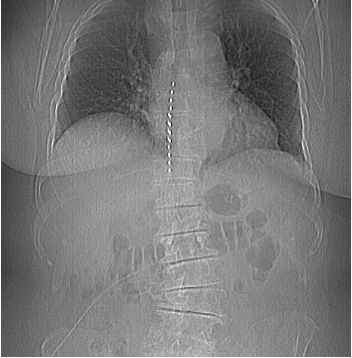
A 48-year-old woman came to us with pain that had outlasted its original cause. The story began in early 2024 with a herniated disc at the L4/5 level, the slipped-disc problem that most people have heard of, where the soft cushion between two vertebrae bulges out and presses on a nearby nerve. It was treated. Then, in the autumn of the same year, it came back. A recurrent herniation at the same level.
What she was left with afterwards was different from what she had started with. The acute, mechanical disc pain settled, but a new kind of pain took its place and refused to leave. It was isolated to the right side, following the path of a single nerve, the right L4. It no longer behaved like a pulled muscle or a bad back. It behaved like a faulty wire.
This is the distinction that matters most in her case. Her pain had become neuropathic, which means the problem was no longer really about the structure of her spine. It was about the nerve signalling itself, a circuit that had been irritated for so long that it kept firing pain even when there was little left to fire about.
If your own back pain has changed character over time, from a deep mechanical ache into something sharper and stranger, that shift is worth taking seriously.
Neuropathic nerve pain tends to feel quite different from ordinary back pain, and patients describe it in surprisingly consistent ways:
- Burning, electric or shooting sensations rather than a dull ache
- Pain that follows a specific line down the leg, in this case along the path of the L4 nerve, toward the front of the thigh and the inner side of the lower leg
- Pins and needles, tingling or numbness in the same track
- Pain triggered by light touch or clothing, where things that should not hurt suddenly do
- Pain that lingers at rest, including at night, instead of easing the moment you stop moving
- A problem that persists or returns after disc treatment, sometimes called persistent pain after spinal surgery
This kind of pain is stubborn precisely because it is not mechanical. You cannot stretch it away or fix it by correcting posture, because the fault is in the wiring, not the frame.
What the scan showed
Her MRI is where the case becomes genuinely interesting, because of what it did not show. There was no high-grade narrowing of the space where the nerve exits the spine, no severe neuroforaminal stenosis crushing the root. Just as importantly, there was no instability. Nothing was slipping, shifting or coming loose. On imaging, the architecture of her spine was holding up perfectly well.
So here was the puzzle. A woman in real, daily, function-limiting pain, with a scan that showed a structurally sound spine. The problem and the picture did not point in the same direction.
The first recommendation
The first opinion came from spine surgery, offered as a one-stop solution to a recurrent disc problem. The plan was a structural one: dorsal instrumentation combined with an XLIF, a fusion that locks the affected segment in place with hardware, approached from the side of the body.
For a disc that keeps failing at the same level, building a solid, fused, non-moving segment is a recognised and evidence-based answer. The reasoning was sound on its own terms.
The logic runs like this. If the disc keeps causing trouble, remove the disc from the equation entirely by fusing the bones above and below it. It is a permanent fix for a recurring mechanical fault, and for the right patient it works well.
But notice the quiet tension. This was a major, irreversible reconstruction of a spine that the scan had just described as stable, proposed for a pain that had become neuropathic rather than mechanical.
The second opinion
Before committing to fusion, she sought a second opinion, this time from an orthopaedic specialist focused on pain.
The conclusion was not a smaller version of the first plan. It was a completely different philosophy. Rather than rebuilding the structure, this approach aimed at the wiring directly through neuromodulation, using two techniques as a first-line option:
- Spinal cord stimulation (SCS), a small implanted device that sends gentle electrical pulses to the spinal cord to interrupt pain signals before they reach the brain
- Dorsal root ganglion (DRG) stimulation, which targets one very specific nerve cluster, making it especially suited to focal, single-nerve pain like her isolated right L4 problem
There is a feature of this route that patients often appreciate once they understand it. Neuromodulation is usually trialled before anything permanent is implanted, and the hardware can be adjusted or removed later. A fusion cannot be undone. One path keeps doors open. The other closes them in exchange for permanence.
She went with neuromodulation. Today she is pain-free and exercising regularly again, with no fusion implant in her spine.
Why this case matters
The lesson here is sharper than in most second-opinion stories, because nobody was wrong.
Same patient. Same diagnosis. Two completely different surgical philosophies, both genuinely evidence-based. The deciding factor was not the medicine. It was which specialty she happened to walk into first.
A spine surgeon, looking at a recurrent disc, reaches naturally for a structural repair, because that is the powerful and effective set of tools they have mastered. A pain specialist, looking at the same patient, sees a neuropathic circuit and reaches for neuromodulation, for the same reason. Each was offering the best of their own discipline. The trouble is that her actual problem, the wiring rather than the frame, happened to sit closer to one toolkit than the other.
She did not need her spine reconstructed. She needed it rewired. And the only way she discovered that the second option even existed was by asking a second specialty.
A word of balance
This is not a verdict against fusion, and it should not be read as one. There are recurrent disc problems where structural surgery is exactly right and clearly superior. The honest takeaway is more uncomfortable and more useful than a simple ranking of treatments: when two reputable, evidence-based paths exist, the recommendation you receive can depend heavily on the door you knocked on.
A second opinion is especially valuable when:
- A major, permanent operation is proposed for a problem your scan describes as stable
- Your pain has turned neuropathic, with burning or electrical qualities, rather than purely mechanical
- The plan comes from a single specialty as the obvious answer, with little mention of alternatives
- You want to know whether a different kind of specialist would see your case differently at all
Which is the real question this case leaves behind, and it is worth carrying into your own care: when one diagnosis has two valid answers, how do you make sure you have seen both before you choose, rather than only the one that sits nearest the specialist in front of you?